


President Donald Trump Claims Fuel Prices Are "Tumbling Down," but Trumpflation Has Become a Broad-Based Problem
President Donald Trump Claims Fuel Prices Are "Tumbling Down," but Trumpflation Has Become a Broad-Based Problem

Sean Williams, The Motley FoolSun, August 23, 2026 at 8:26 AM UTC
0
Key Points -
Despite well-above-average inflation, the Dow Jones Industrial Average, S&P 500, and Nasdaq Composite have continued to climb the proverbial wall of worry.
President Trump predicts that energy prices will plummet once the Iran war concludes.
However, the price stickiness of Core Personal Consumption Expenditures (PCE) indicates that Trump-driven inflation (I.e., Trumpflation) has spread beyond the energy sector.
10 stocks we like better than S&P 500 Index ›
&&
Look up the word "resiliency" in a dictionary, and you'd probably see a photo of the U.S. stock market, which has been climbing a wall of worry for years. Since early June, the time-tested Dow Jones Industrial Average(DJINDICES: ^DJI), benchmark S&P 500(SNPINDEX: ^GSPC), and innovation-driven Nasdaq Composite(NASDAQINDEX: ^IXIC) have each blasted to record highs.
This ongoing outperformance has occurred despite concerns of an artificial intelligence (AI) bubble taking shape, and with outstanding margin debt soaring. But the biggest risk of all to the high-flying stock market is above-average inflation.
Missed Nvidia in 2009? This Rare Signal Is Flashing Again.In 2009, a "Double Down" signal flashed for a little-known chipmaker called Nvidia. For the first time in years, that same "Total Conviction" signal is flashing for a company 1/100th the size of Nvidia. Continue »
&&
Although modest inflation (rising prices) is perfectly normal for an expanding economy, actions taken by President Donald Trump have directly affected domestic prices. While the president has assured the public that prices will come "tumbling down" once the Iran war is over, Trumpflation data tells a completely different story.
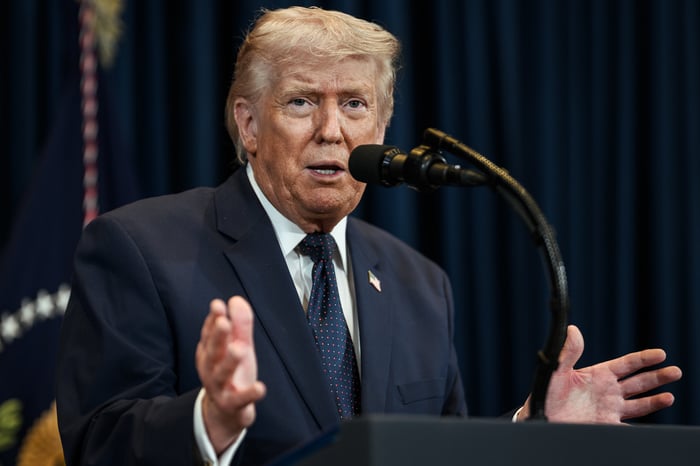
President Trump insists that fuel prices will tumble once the Iran war is resolved. Image source: Official White House Photo by Daniel Torok.
President Trump pitches lower fuel costs to consumers
Trumpflation (inflation that's specifically driven by President Trump's policies) comes in two forms: tariffs and the Iran war.
For more than a year, Fed Chairs Jerome Powell and Kevin Warsh have cited the president's tariffs as modestly lifting consumer prices in the goods sector. With the Trump administration recently imposing a new round of sweeping global tariffs, ranging from 10% to 12.5% on more than 80 countries, this inflationary dynamic is expected to continue.
However, the more prominent source of inflation has been the Iran war. Shortly after President Trump green-lit military operations against Iran, the latter shut down the Strait of Hormuz to virtually all maritime traffic. This essentially halted the flow of a fifth of the world's petroleum liquids.
In the weeks that followed, gas prices skyrocketed at the fastest pace in three decades. This parabolic increase in fuel prices, in the wake of the largest modern-day energy supply disruption, almost single-handedly sent trailing 12-month inflation (TTM) to a three-year high of 4.2% in May.
However, President Trump has been adamant that Iran war-driven inflation, including elevated fuel prices, will come crashing down once the conflict is resolved.
In March, the president responded to reporters by stating, "Well, I think your gas prices, as soon as that's over, are going to come tumbling down along with everything else."
Three months later, in mid-June, the White House (courtesy of President Trump) tweeted that "oil is flowing and gas prices have begun tumbling down, now below $4 per gallon nationally."
The prospect of peace talks between the U.S. and Iran has indeed driven West Texas Intermediate and Brent crude oil prices well below their Iran war highs. Although fuel prices react to the upside almost immediately when energy supply shocks occur, they historically fall like a feather once these supply issues are resolved.
While fuel prices aren't exactly "tumbling down" as the president put it, they have notably retraced in recent months.
Unfortunately for consumers and the stock market, energy prices aren't the headline story any longer.
Advertisement
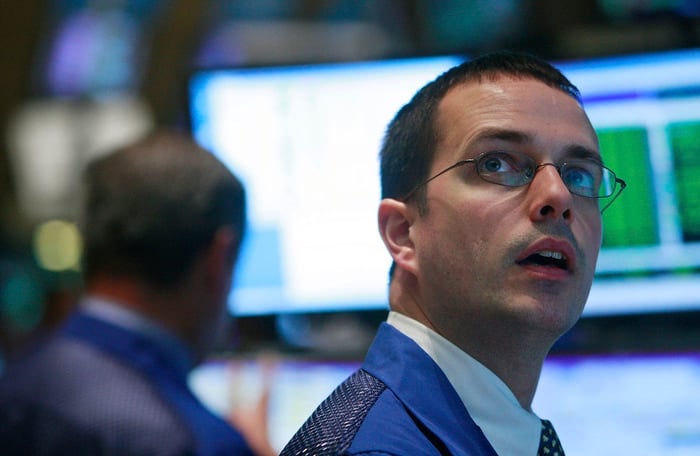
Image source: Getty Images.
Trumpflation is becoming entrenched in the broader economy -- and that's a big-time problem
On the surface, the June and July inflation reports appear to be a silver lining for consumers, with TTM inflation falling to 3.5% in June (down from 4.2% in May) and 3.4% in July. But an all-important inflation figure points to Trumpflation digging its proverbial heels into the broader economy.
In May, when headline inflation hit a three-year high of 4.2%, Core Personal Consumption Expenditures (PCE) reached 3.4%, its highest level since October 2023. Core PCE excludes volatile food and energy costs, providing economists and investors with a clearer understanding of long-term price trends.
While headline inflation has retraced by 80 basis points to 3.4% over the last two months, Core PCE for June eased to just 3.3%. According to the Federal Reserve Bank of Cleveland's Inflation Nowcasting tool, Core PCE is projected to essentially hover at 3.29% in July and 3.34% in August. The price stickiness of this all-important measure of inflation indicates that the effects of Trumpflation have moved well beyond the energy sector.
For instance, some businesses have been forced to reroute shipments, change transportation methods entirely, or alter their suppliers in lieu of the Strait of Hormuz's closure. These changes are increasing production costs that businesses are, in many cases, passing on to consumers. This structural inflation is considerably tougher to remove than generally short-lived energy supply shocks.
Trumpflation becoming a broad-based economic issue is terrible news for Fed Chair Kevin Warsh and his central bank colleagues, as well as the stock market.
Since Kevin Warsh was sworn in as Fed chair on May 22, Treasury bond yields at the long end of the yield curve have soared, highlighted by the 30-year yield hitting a 25-year high. But if Trumpflation digs in its heels, it's going to take more than just bond traders to deliver price stability. Warsh and the Federal Open Market Committee (FOMC) may be forced to act and raise the federal funds target rate to bring prices down.
Trumpflation prompting the FOMC to raise interest rates wouldn't go over well on Wall Street. The AI data center build-out is the primary catalyst responsible for lifting the Dow Jones Industrial Average, S&P 500, and Nasdaq Composite to new heights. The otherworldly spending on this infrastructure build-out is being partially financed using debt. If lending costs rise and the AI build-out slows, even marginally, it could spell disaster for the second-priciest stock market in history.
Even if the Iran war officially ends relatively soon, the inflationary effects of Trumpflation should stick around for a while.
Should you buy stock in S&P 500 Index right now?
Before you buy stock in S&P 500 Index, consider this:
The Motley Fool Stock Advisor analyst team just identified what they believe are the 10 best stocks for investors to buy now… and S&P 500 Index wasn’t one of them. The 10 stocks that made the cut could produce monster returns in the coming years.
Consider when Netflix made this list on December 17, 2004... if you invested $1,000 at the time of our recommendation, you’d have $429,223!* Or when Nvidia made this list on April 15, 2005... if you invested $1,000 at the time of our recommendation, you’d have $1,318,055!*
Now, it’s worth noting Stock Advisor’s total average return is 965% — a market-crushing outperformance compared to 212% for the S&P 500. Don't miss the latest top 10 list, available with Stock Advisor, and join an investing community built by individual investors for individual investors.
See the 10 stocks »
*Stock Advisor returns as of August 23, 2026.
&&
Sean Williams has no position in any of the stocks mentioned. The Motley Fool has no position in any of the stocks mentioned. The Motley Fool has a disclosure policy.
Source: “AOL Money”
