


Dyson backs call to revive polytechnic-style universities
Dyson backs call to revive polytechnic-style universities

Albert TaitMon, October 19, 2026 at 9:00 PM UTC
0

Sir James Dyson says that without training engineers the UK will be unable to compete globally - Press Association/Isabel InfantesSir James Dyson has backed a report calling for a new wave of technical education universities to help Britain “compete against the rest of the world”.
Sir James Dyson has backed a report calling for a new wave of technical education universities to help Britain “compete against the rest of the world”.
The billionaire endorsed the paper by the Policy Exchange think tank which argues that traditional three-year university degrees have “not delivered the skills that the modern economy needs”.
It calls on the Government to establish a £50m fund to seed up to 10 new universities built explicitly to deliver employer-focused technical and engineering skills.
Sir James, the founder of the technology company Dyson, said: “Britain doesn’t produce enough engineers. Only about one in 11 British graduates studied engineering or related subjects. Without them, we can’t make things, invent new products and technologies – or compete against the rest of the world.
“Britain needs many more places like these. This report shows how to build them.”
The report comes after the number of young people aged 16 to 24 not in education, employment or training (Neets) topped a million earlier this year for the first time in more than a decade.
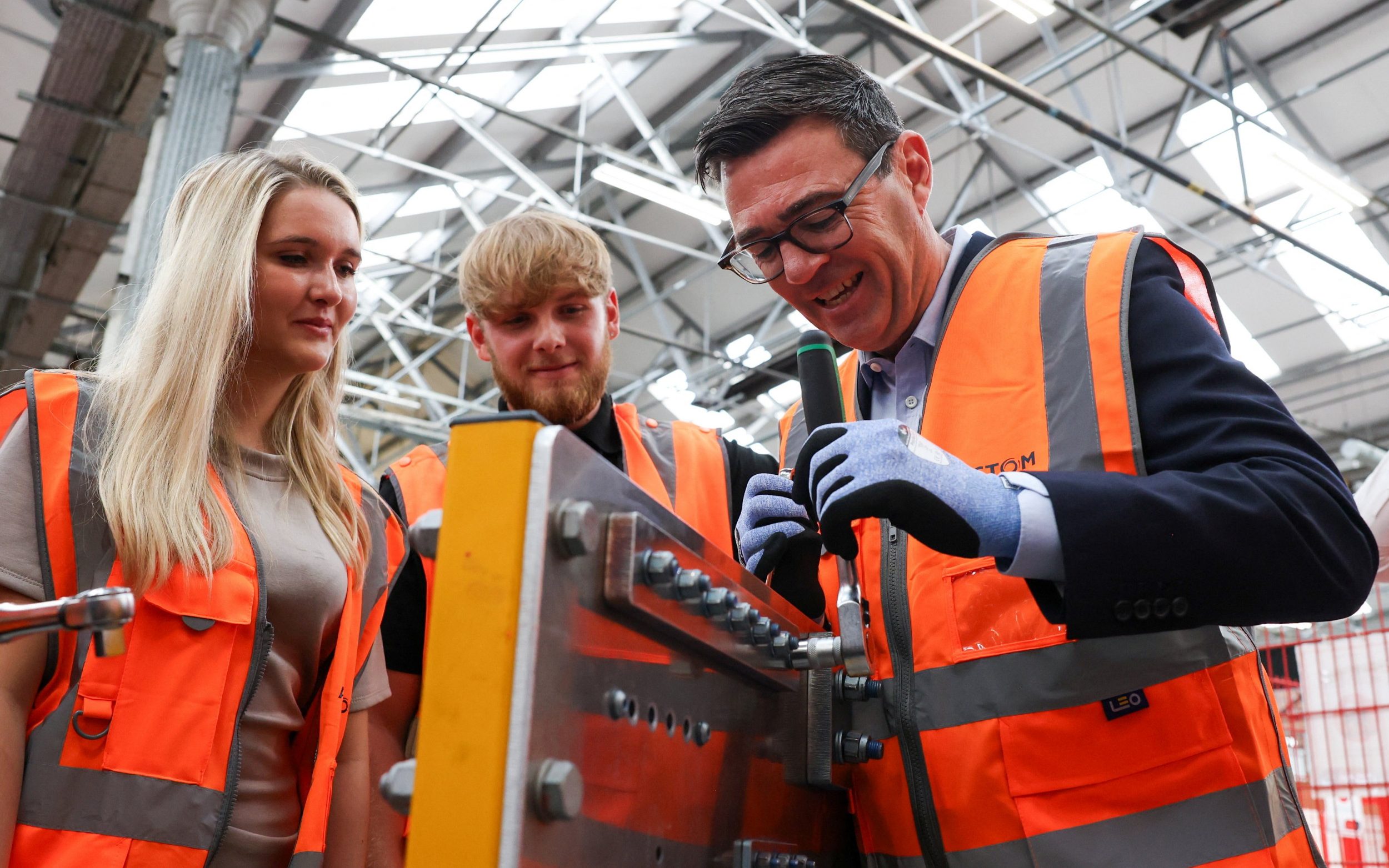
Andy Burnham, pictured during a visit to the train manufacturer Alstom in Derby, wants more opportunities for technical education - Getty Images/Temilade Adelaja
Andy Burnham has pledged to expand technical education since becoming Prime Minister and said that under his leadership Britain would “value the hard hat every bit as much as the graduation cap”.
Policy Exchange’s paper argues that too many young people are acquiring qualifications of “limited economic value” when employers need a more skilled workforce.
Advertisement
Its authors say that technical skills had been lost with the demise of polytechnics in the UK in the 1990s and the proposed new universities would be a modern and improved way of delivering such skills.
They say the new universities should be modelled on the New Model Institute for Technology and Engineering (NMITE) in Hereford – an employer-focused technical institution which teaches engineering skills through block-taught modules, a nine-to-five working week, and offers a two-year degree.

Students at work at NMITE in Hereford, a model for next-generation universities - NMITE
The report assessed 57 English towns and cities of 60,000 people or more with no university of their own, and it found the “strongest cases” for new technical institutions were overwhelmingly in the north – including Hartlepool, Grimsby, Doncaster and Barnsley.
Byron Evans, research fellow and co-author of the report, said: “Our higher education system is beginning to buckle – contributing to regional, social and economic ills.
“British history and our European neighbours show that technical educational institutions require a distinct and explicit focus to guard against academic drift.
“Fundamentally, a roll-out of NMITE-type universities offers much needed diversity in degree-level provision – while supporting the crucial bedrock of technical skills required for any serious re-industrialisation of Britain.”
Lord Blunkett, the former Labour education secretary, who also endorsed the report, said: “Differential access to skills is one of the key drivers of regional inequality across Britain. The post-16 journey is vital for the needs of both SMEs [small and medium-sized enterprises] and the large infrastructure programmes, which will be the driving force of substantial economic growth.”
He added that the report “argues convincingly” that a new wave of technical institutions could provide “valuable opportunities to talented young people ... for whom the system is not delivering”.
Source: “AOL Money”
